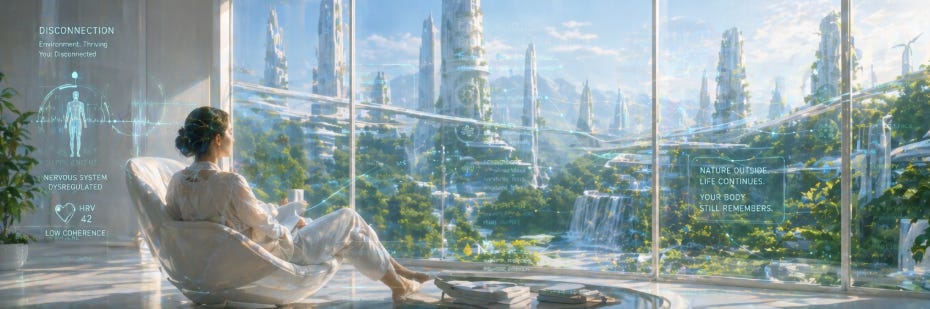
Something has been missing from the conversation about nature and wellbeing.
We talk about forest bathing, biophilic design, green spaces in cities. We talk about how good it feels to be outside. But we rarely ask the deeper question: why does the body already know how to be in nature, and what does it cost us when we take it away?
That question is the spine of a chapter I’ve written for a forthcoming Springer publication, Contemplative Ecological Practices in Education. It is the most integrated account I have written to date of why our relationship with the natural world is not optional, not aesthetic, and not a wellness trend. It is biological, psychological, spiritual. And it is architectural.
The chapter is titled Transpersonal Ecology: Bridging the Sacredness of Nature and Ecotherapy. What follows is the heart of it.
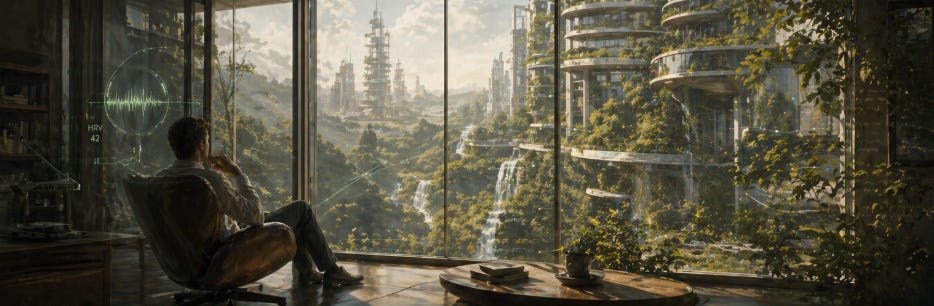
We have been asking the wrong question.
For decades, the conversation around nature and human wellbeing has centred on whether spending time outdoors is good for us. The evidence is conclusive: it is. Reduced stress, improved mood, enhanced cognitive function, greater resilience. We know this. And yet the framing has always placed nature in the role of treatment: something we access, consume, and return from.
The chapter argues for a different question entirely. Not “is nature good for us?” but: what happens to the human body when it is cut off from the conditions under which it learned to regulate itself, over hundreds of thousands of years of evolution?
Nature is not a supplement. It is the substrate. Our nervous systems evolved in continuous contact with the sensory, thermal, acoustic and biotic conditions of the living world. The body did not evolve to occasionally visit a park. It evolved in the wild, and it still expects to be there.
What transpersonal ecology actually is
The field that holds this understanding is called transpersonal ecology. Coined by the philosopher Warwick Fox, it brings together three domains that rarely appear in the same room: the spiritual reverence for nature found in indigenous and contemplative traditions; the psychological and therapeutic dimension of engaging with the natural world (what we now call ecotherapy); and the science of how human bodies respond to their environments.
It draws on ecopsychology, the understanding that the human psyche is inherently attuned to the natural world, and that disconnection from it carries real psychological cost. It draws on deep ecology and environmental philosophy, the recognition that nature has intrinsic value, that all life is interconnected, and that our dominant relationship with the Earth must change. And it draws on transpersonal psychology, the study of self-transcendent experience, peak states, and the spiritual dimensions of consciousness.
From Edward O. Wilson’s biophilia hypothesis (that humans have an innate, evolutionary need to affiliate with other living systems) to Theodore Roszak’s concept of the ecological unconscious, the evidence converges: disconnection from the natural world is not a lifestyle inconvenience. It is a source of measurable harm. And it is continuous: it is happening to us now, in the buildings we are sitting in, the cities we are walking through, the indoor air we are breathing.
This is the argument the chapter makes in full. The remainder of this essay sets out what it means in practice: for clinicians, for educators, for designers, and for any of us trying to live well inside the environments we have built.