

Every peace agreement in history has been negotiated by nervous systems.
We do not usually put it that way. We talk about parties and positions, about terms and treaties, about political will. What we rarely say is that the people in the room are bodies. That bodies are regulated or dysregulated by the conditions they are sitting in. And that a person who has slept badly, who is too hot, who cannot hear clearly, who has no control over the space around them, is measurably worse at patience and at judging what another person intends.
Peace is not only an agreement between parties. It is a condition of the people who have to keep it.
This December, the Global Energy Parliament holds its 16th annual session in Thiruvananthapuram, Kerala. It is a volunteer body convened by the Isa Viswa Prajnana Trust, which has held consultative status with the United Nations Economic and Social Council since 2015. It works as a genuine parliament. Members hear evidence, debate, and vote on Acts and Resolutions which are then conveyed to national governments. Previous sessions have been addressed by heads of state, by the former chairman of the Indian Space Research Organisation, and by the chairman of the Nobel-winning Pugwash Conferences.
This year the theme is the foundations of peace: the personal, social and institutional conditions that make it possible.
They invited me to contribute. I have sent them a resolution.

The argument
We spend our lives indoors. The National Human Activity Pattern Survey, still the most detailed study of its kind, found that people spend 87 per cent of their time inside buildings and a further 6 per cent inside vehicles. That is 93 per cent of a life spent inside something someone designed.
None of that is neutral. It is a continuous biological input, and we have almost no policy that treats it as one.
Consider what is already established. Elevated indoor temperature degrades cognitive performance, shown in students living through a heat wave in buildings with and without air conditioning. Road traffic noise above 53 decibels Lden is associated with adverse health effects, which is why the World Health Organization sets it as a threshold. Carbon dioxide and volatile organic compound concentrations affect cognitive function, demonstrated in controlled comparisons of real office environments. Daylight in the workplace affects sleep quality. Being able to open a window, adjust a shade or control your own ventilation widens the range of conditions you will tolerate without stress, which is one of the oldest findings in thermal comfort research and the one my own doctorate sat inside.
And these do not resolve between exposures. They accumulate. That is what allostatic load describes: the cumulative physiological cost of adapting, over and over, to conditions the body has to work against.
Now put that next to peace.
The configuration of a place determines who encounters whom and how often. That is not a metaphor, it is the substance of space syntax, developed at University College London, which showed that layout produces patterns of co-presence rather than merely housing them. And sustained contact between unfamiliar groups is among the best evidenced means of reducing prejudice between them, established in a meta-analysis drawing on more than five hundred studies.
Layout produces encounter. Encounter reduces threat.
So the built environment is not only a matter of comfort or of carbon. It is one of the conditions under which a population is capable of peace, and it is among the most governable conditions we have. You cannot legislate patience. You can legislate a ventilation standard.
Why Kerala is the right place to say this
There is a particular reason this argument belongs in Thiruvananthapuram.
Laurie Baker was a Birmingham-born, British-trained architect who moved to India, took Indian citizenship in 1988, and lived and built in Thiruvananthapuram from 1969 until his death in 2007. He built for people with very little money, in unplastered brick, in a tropical climate, without air conditioning.
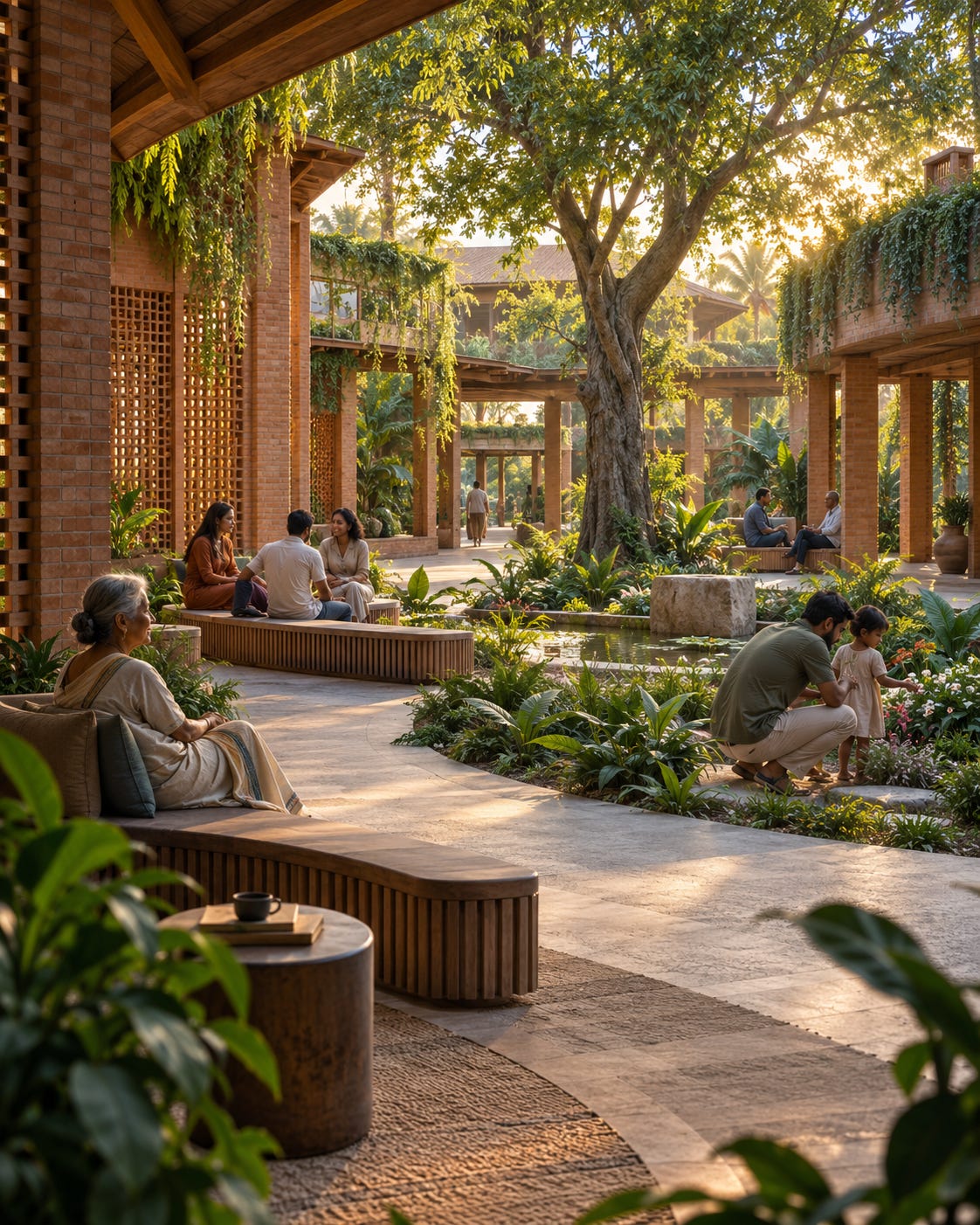
His signature device was the jali (not unfamiliar to India), a perforated brick screen that blocks the sun while letting the air through. He pitched roofs into the prevailing wind. At the Centre for Development Studies, a campus he completed in 1971, he cooled the buildings using a high latticed wall set against a pond.

That is thermal comfort achieved through geometry and material rather than machinery and fuel. At scale. Fifty-five years ago. Twenty minutes from where the Parliament will sit.
The design world reads Baker as low-cost vernacular architecture, which he was. I think he was also something else. He was regulating human physiology through form, half a century before anyone had the language for it. In a city that holds one of the most complete modern records of climate-responsive building anywhere in the world, it seems worth saying so out loud.
What I have asked the Parliament to do
The resolution is deliberately practical. It asks for seven things.
That the physiological condition of building occupants be recognised as a foundation of peace, and treated as a measurable object of building policy.
That thermal, acoustic, air quality and lighting standards be evaluated against their effect on the human body, and not against equipment performance and energy accounting alone.
That occupant control over the immediate environment, meaning the openable window, the adjustable shade and the local means of ventilation, be treated as a provision for health rather than as an amenity.
That governments assess and publicly report the conditions of the buildings in which people have least choice about being: schools, clinics and hospitals, courts, places of detention, workplaces, and public housing.
That the climate-responsive building traditions of each region be documented, taught and treated as public health infrastructure rather than as heritage.
That a working group be convened to define measurable indicators, reporting to the 17th session.
And that the resolution be conveyed to national governments, and additionally to UN-Habitat, the World Health Organization and the United Nations Environment Programme.
The fourth of those is the one I care most about. The people who have least say over the rooms they spend their days in are children, patients, prisoners, and anyone living in housing they did not choose. They are also the people for whom the accumulated load is heaviest. If this is a matter of justice as well as of physiology, that is where it shows.
Where this sits
This is the first formal application of Nervous System Compliant™ design outside my own writing, and it is a test of something I have argued for a while: that the standard has to be usable by people making policy, not only by people designing buildings.
The resolution deliberately does not rest on any contested theory of how the autonomic nervous system evolved. It measures environments and outcomes rather than mechanisms, because that is the level at which building policy operates in any case. Whichever way the arguments in that literature resolve, heat still degrades cognition, noise still tracks cardiovascular risk, and a view of living things still tracks faster recovery in hospital.
I do not know whether it will be tabled, amended or set aside. That is the Parliament’s to decide, and I have written it to be amended.
But the argument should not have to wait for a vote to be made in public. So here it is.
References
Allen, J. G., MacNaughton, P., Satish, U., Santanam, S., Vallarino, J., and Spengler, J. D. (2016). Associations of cognitive function scores with carbon dioxide, ventilation, and volatile organic compound exposures in office workers: a controlled exposure study of green and conventional office environments. Environmental Health Perspectives, 124(6), 805 to 812. doi:10.1289/ehp.1510037
Boubekri, M., Cheung, I. N., Reid, K. J., Wang, C. H., and Zee, P. C. (2014). Impact of windows and daylight exposure on overall health and sleep quality of office workers: a case control pilot study. Journal of Clinical Sleep Medicine, 10(6), 603 to 611. doi:10.5664/jcsm.3780
Brager, G. S., and de Dear, R. J. (1998). Thermal adaptation in the built environment: a literature review. Energy and Buildings, 27(1), 83 to 96. doi:10.1016/S0378-7788(97)00053-4
Cedeño Laurent, J. G., Williams, A., Oulhote, Y., Zanobetti, A., Allen, J. G., and Spengler, J. D. (2018). Reduced cognitive function during a heat wave among residents of non-air-conditioned buildings: an observational study of young adults in the summer of 2016. PLOS Medicine, 15(7), e1002605. doi:10.1371/journal.pmed.1002605
Hillier, B., and Hanson, J. (1984). The Social Logic of Space. Cambridge: Cambridge University Press.
Kansara, T. (2026) Introducing Nervous System Compliant™ Design. Substsack
Klepeis, N. E., Nelson, W. C., Ott, W. R., Robinson, J. P., Tsang, A. M., Switzer, P., Behar, J. V., Hern, S. C., and Engelmann, W. H. (2001). The National Human Activity Pattern Survey (NHAPS): a resource for assessing exposure to environmental pollutants. Journal of Exposure Analysis and Environmental Epidemiology, 11(3), 231 to 252. doi:10.1038/sj.jea.7500165
McEwen, B. S. (1998). Protective and damaging effects of stress mediators. New England Journal of Medicine, 338(3), 171 to 179. doi:10.1056/NEJM199801153380307
Pettigrew, T. F., and Tropp, L. R. (2006). A meta-analytic test of intergroup contact theory. Journal of Personality and Social Psychology, 90(5), 751 to 783. doi:10.1037/0022-3514.90.5.751
Ulrich, R. S. (1984). View through a window may influence recovery from surgery. Science, 224(4647), 420 to 421. doi:10.1126/science.6143402
World Health Organization Regional Office for Europe (2018). Environmental Noise Guidelines for the European Region. Copenhagen: WHO Regional Office for Europe. ISBN 9789289053563.
