

There is a particular kind of honour in being seen alongside people whose work you deeply respect. When RE:TV included me in a feature ahead of International Women’s Day - placing Replenish Earth among organisations working across hydrogen energy, regenerative agriculture, carbon removal and wetland restoration, my first feeling was not pride. It was recognition and deep gratitude.
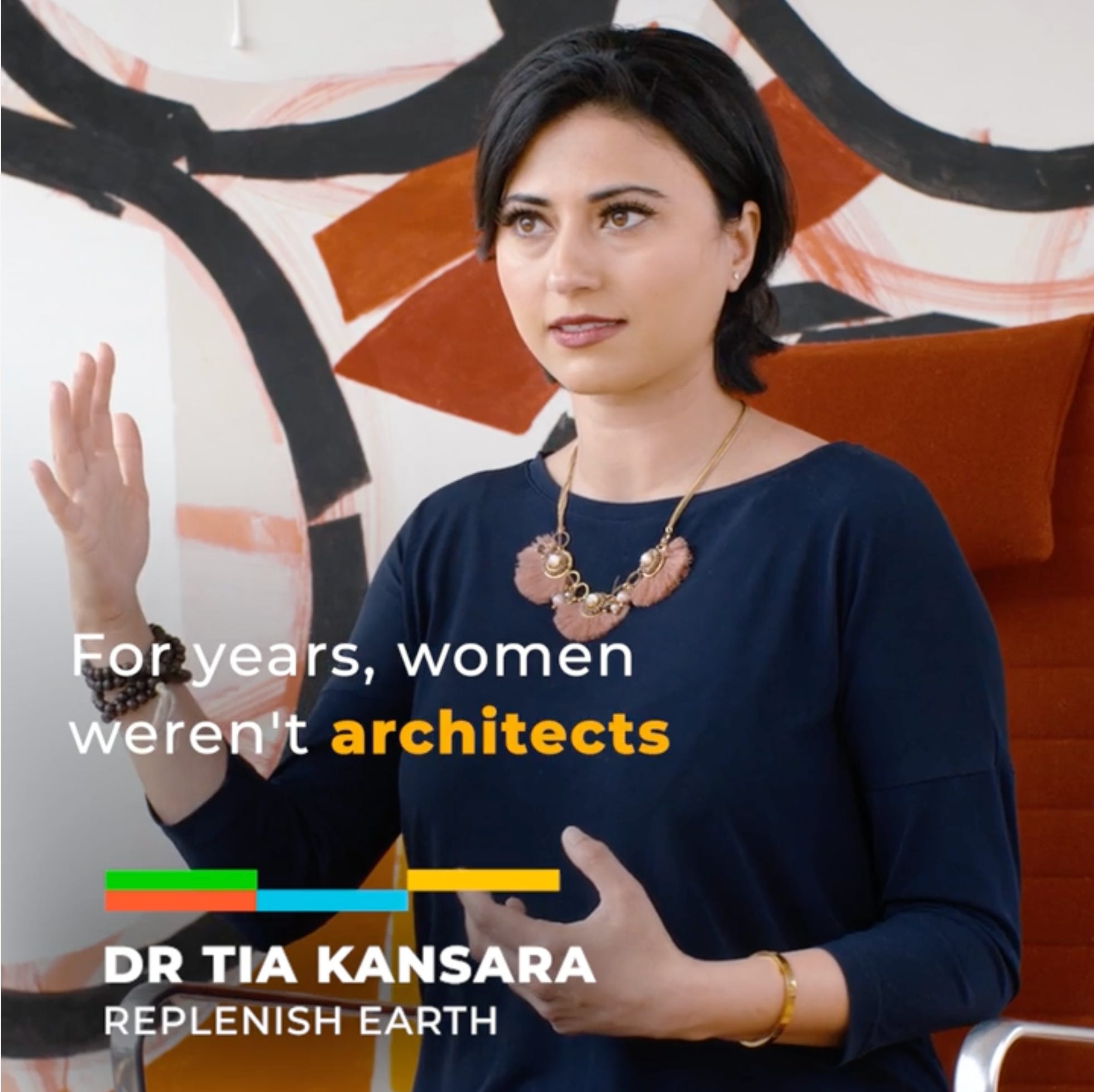
Recognition of something I have been trying to articulate for years: that the most important shifts happening in the world right now are not occurring in any single field. They are occurring across many fields simultaneously, and the pattern they reveal together is far more significant than any one of them in isolation.
Consider the work represented in that post. Toni J E Beukes is leading ESG for HYPHEN Hydrogen Energy, a gigawatt-scale green hydrogen project in Namibia - one of the most ambitious clean energy initiatives on the African continent. Julie Greene, as CSO of Olam Agri, is driving regenerative rice farming programmes that have reached smallholder farmers across Thailand, Vietnam and India. Kelly Erhart co-founded Vesta, PBC, to accelerate natural chemical weathering using olivine, harnessing the planet’s own mineral chemistry to draw down carbon. Sarah Fowler leads WWT, the Wildfowl and Wetlands Trust, with a mission to restore wetlands as among the world’s most effective carbon sinks.
And then there is the work of Replenish Earth - supporting governments and businesses to build genuine climate resilience, not just compliance.
Energy. Agriculture. Carbon cycles. Ecological restoration. Urban and institutional resilience. On the surface, these are five separate domains. But look again.
What connects these projects is not their subject matter. It is their underlying logic. Every one of them is working with natural systems rather than against them. Every one of them is seeking to restore function rather than simply extract value. Every one of them is asking a fundamentally different question from the one that has dominated industrial thinking for two centuries not “How much can we take?” but “How much can we give back while still meeting human needs?”
This is the shift from extraction to regeneration. And it is not a marginal conversation happening at the edges of academia or activism. It is being built, funded, scaled and led by organisations working at the intersection of commerce, ecology and governance.
Regenerative thinking is not a new concept. Indigenous knowledge systems have held it for millennia the idea that human wellbeing is inseparable from the health of the living systems we inhabit. What is new is its emergence within institutional and industrial contexts, and the speed at which it is spreading across domains.
In energy, we are moving beyond the transition from fossil fuels to renewables which, for all its importance, is still largely a substitution story toward the design of energy systems that are genuinely integrated with ecological and social realities. Green hydrogen produced at scale in Namibia is not simply a cleaner fuel. It is a proposition about where energy sovereignty might be located in the twenty-first century.
In agriculture, regenerative practice is not simply about reducing chemical inputs. It is about redesigning the relationship between food production and ecosystem health recognising that soil is not a substrate to be managed but a living system to be tended. When smallholder farmers in Southeast Asia improve their practices through regenerative programmes, it is not a charitable intervention. It is a recalibration of the entire value chain.
In carbon removal, enhanced weathering approaches like Vesta’s work with olivine point toward something elegant: using the planet’s own geochemical processes as partners in climate stabilisation. This is not engineering the atmosphere. It is learning from four billion years of planetary chemistry.
And in ecological restoration, wetlands remind us that some of the most powerful carbon sinks and biodiversity habitats on Earth are not technological inventions. They are ancient systems that we have spent two centuries draining and degrading, and which, if we allow them to will restore themselves.
I use the phrase “civilisation signals” deliberately. A signal is not proof of a trend. It is an early indication a data point that becomes meaningful only when read alongside others.
Individually, each of these projects could be read as a response to a specific problem: climate change, food security, biodiversity loss, urban fragility. But collectively, they suggest something larger: that across multiple domains of human activity, a common insight is arriving. The insight that the extractive model- the model that treats natural systems as resources to be consumed, social systems as labour to be deployed, and time horizons as a problem to be discounted - is reaching its structural limits. These projects are not just responding to that limit. They are building what comes next. And what comes next is regenerative.
The reason these transitions are difficult is not primarily technical. It is systemic. We are not dealing with isolated problems that can be solved by better technology inserted into existing systems. We are dealing with system-level failures that require system-level redesign.
This distinction matters enormously in practice. Optimising an extractive system making it more efficient, less wasteful, slightly less harmful does not change its fundamental orientation. A more efficient feedlot is still a feedlot. A greener supply chain that still externalises ecological costs is still extractive at its core.
Redesigning a system requires asking different questions from the outset. Not “How do we do this better?” but “What are we actually trying to achieve, and what kind of system would produce that outcome as a natural consequence of its operation?” This is the kind of thinking that regenerative agriculture, ecological restoration and systemic climate resilience work require and it is the kind of thinking that is genuinely difficult to hold inside institutions that are structured around quarterly performance cycles and siloed disciplines.
The women in that RE:TV post are, among many other things, demonstrating that it is possible and necessary to hold that kind of thinking inside real organisations, with real constraints, at real scale.
The RE:TV post opened with a line I keep returning to: “To build resilient systems, we need representative leadership.” It is a simple sentence, and it risks being read as a statement about inclusion for its own sake. But I think it points to something more precise.The kinds of transitions described above are not merely technical challenges. They are challenges of perspective. Regenerative thinking the ability to see systems whole, to design for long-term health rather than short-term extraction, to hold the interests of future generations and non-human life as legitimate considerations in present decision-making is not distributed randomly. It tends to emerge from people whose relationship to the world has required them to think in terms of interdependence rather than dominance.
This is not a claim about gender as destiny. It is an observation about the relationship between lived experience and the capacity for certain kinds of systemic thinking. When leadership is genuinely representative of place, of culture, of discipline, of relationship to land and community the systems it builds tend to be more robust, more adaptive and more durable. Because they have been stress-tested against a wider range of realities from the outset.
I am not optimistic in the sense of believing that everything will work out. I am optimistic in the sense of believing that the work is worth doing, that the direction of travel is discernible, and that the people doing it are building something real.
We are at an early stage of a very long transition. The extractive systems that have shaped the modern world are not going to dissolve quickly. They are deeply embedded in infrastructure, in institutions, in incentive structures and in habits of mind. The regenerative systems being built to replace them are still fragile, still contested, still finding their footing in a world that was not designed to accommodate them.
But the signals are real. They are multiplying. And the people reading them correctly and building accordingly are not waiting for permission. That, in the end, is what International Women’s Day is for not celebration in the abstract, but recognition of the specific. Of the people who are doing the work that the moment requires, in the face of systems that were not built for them, toward a future that will be built by them.
The future is regenerative. These are its signals.
