


I started studying Japanese when I was fourteen. Nobody suggested it. Something about Japan's understanding of the body and its surroundings as continuous rather than separate had reached me through books, through aesthetic, through an intuition I couldn't yet name.
By 2005 I was living in Iwaki, and my colleagues ate natto every morning without ceremony. Small polystyrene tubs, fermented soybeans, pungent and threaded with sticky protein strings that refused to stay on chopsticks. My first bowl was a genuine ordeal. My third changed something.
Within weeks I was eating it daily, voluntarily, enthusiastically. As a vegetarian I still consider it among the most complete breakfasts available anywhere on earth: fermented, protein-dense, alive in a way that processed food is not, and ancient in a way that matters biologically.
I would eat it every day if I could get my hands on it. That gap between a living food tradition and the people who have been severed from it is the thread running through twenty years of my work and into something that launched this week.
The organism fermenting those soybeans is Bacillus subtilis. Lynn Margulis spent decades arguing that bacteria are not primitive precursors to complex life but its continuing foundation, and that the hard boundary we draw between the human body and the microbial world is a conceptual error with serious biological consequences. She was right, and those consequences are now measurable at every scale. B. subtilis lives in soil rhizospheres, in fermented food, in the human gut.
It produces nattokinase, MK-7, and surfactin. It also, according to a comprehensive 2025 review in the Journal of Environmental Management, degrades glyphosate (71% mineralisation in living non-sterile soil within four days), synthetic pyrethroids, industrial phenols, mycotoxins, and low-density polyethylene. Not sequestration. Actual molecular dismantlement, the constituent atoms returned to biological cycle.
The 2015 Yu et al. study found that introducing the organism into contaminated soil not only degraded the herbicide but restored functional microbial diversity across five independent ecological indices. A keystone species re-assembling a collapsed ecosystem.
It does none of this individually. The pyrethroid detoxification response is quorum-regulated: the colony emits a chemical signal, waits for collective consensus, and only then commits to producing the enzymes. Two independent research groups confirmed this through DNA pull-down and yeast one-hybrid assays. The bacterium acts as a collective before it acts at all.
“In nature, nothing exists alone.” — Rachel Carson, Silent Spring, 1962
In my Silent Spring Reawakened essay, I wrote that this may have been Carson’s single most radical sentence: a marine biologist in an era of reductionist science describing the world as relational and whole before systems thinking had a name.
What she could not have known is that the bacterium in the natto bowl in Iwaki would turn out to be one of the most potent documented remedies for precisely the class of synthetic molecules she was warning us about. She named the wound. The remedy was already in the soil - who knew?

Sayer Ji, my partner, has been making this case in careful, referenced detail across two decades. He is the founder of GreenMedInfo, one of the world’s largest open-access databases of peer-reviewed natural health research, with over 100,000 studies indexed.
His recent Substack essays, The Ancient Bacterium That Eats Roundup and The Bacterium That Eats the Industrial Age’s Plastics, Pesticides and Poisons, lay out the bioremediation evidence in the kind of depth that only someone with twenty years of literature synthesis behind them can manage.
The second piece documents what he calls the holobiont’s immune response to the petrochemical age: a single ancient organism, without genetic modification and without human design, degrading the better part of the chemical legacy of industrial civilisation. He is not a supplement entrepreneur who found a trending ingredient. He is a researcher who spent two decades building the evidence base before deciding what formula that evidence actually warranted.
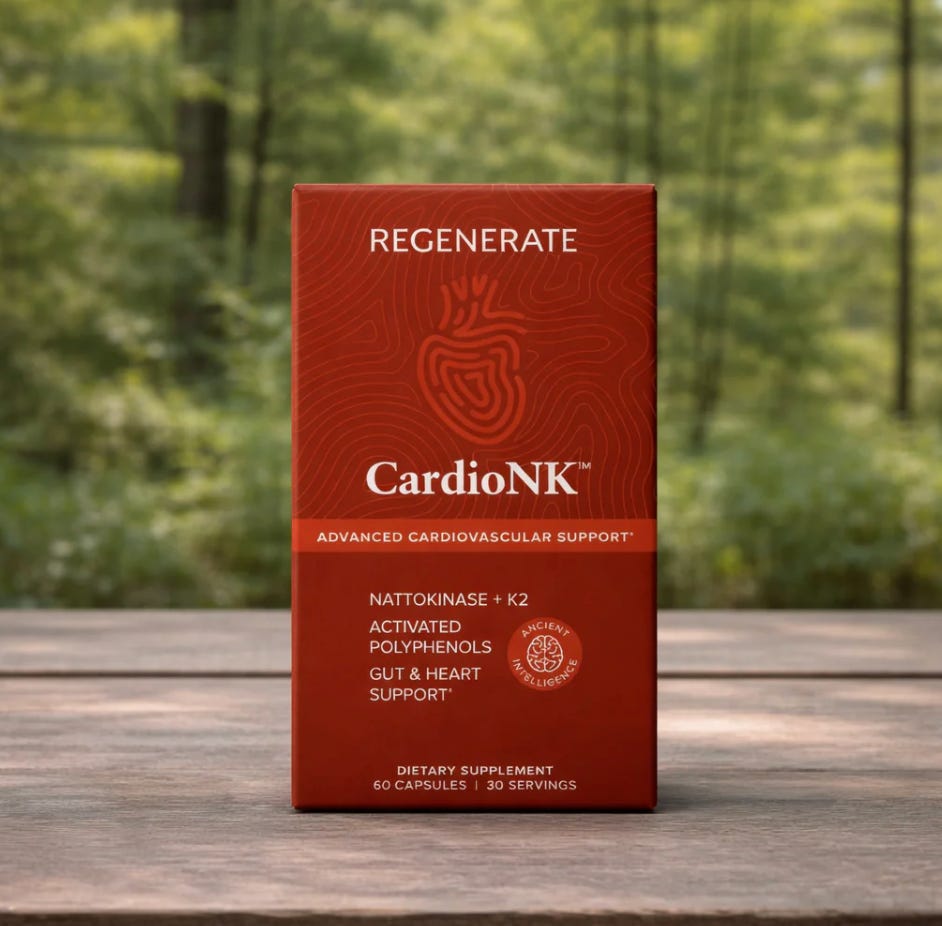
CardioNK is the result, his first product, built around what he calls the Regenerative Natto Complex: nattokinase at a clinically relevant dose, the AB22™ strain of B. subtilis, and MK-7, delivered together the way the natto ferment always delivered them, with the parent organism still present. Farm-to-capsule. No excipients. Small-batch.
In January 2026 I was in Seoul at the 55th Codex Alimentarius Committee on Food Additives, interviewing Scott Tips, President of the National Health Federation, for my Together We Rise podcast.
NHF is the only consumer health INGO with a seat at the Codex table, spending decades defending nutritional freedom and resisting the institutional drift that edges industry interest above public health in global food standards. The full account is in my Silent Heroes, Sovereign Choices piece. It maps directly onto the systemic argument in From Extraction to Regeneration: food systems that externalise their harms onto soil, microbiome, and human health are not making progress. They are deferring a cost that living systems will eventually present.
Which is why last year, standing on Heal the Planet Farm in Tennessee, I found the conversation I had been waiting for. I was there to interview Jordan Rubin, regenerative organic farmer, author of The Biblio Diet, farming on seven-year sabbatical soil cycles with 600,000 fruit trees planned, for Together We Rise as my passion has always been the Replenish Earth. Alongside him was Sayer.
This formula came from that farm and that conversation, for everyone who doesn’t have a Japanese breakfast table within reach.
My own work has converged on the same argument at different scales. My Springer chapter on transpersonal ecology argues that nature is not a wellness amenity. It is a biological substrate, and our nervous systems evolved in continuous biotic, sensory, and thermal contact with the living world.
This is the same premise underlying my Nervous System Compliant™ design standard: twenty years of evidence, a UCL PhD across 190,000 buildings in Abu Dhabi, a six-dimensional criterion set for whether a built space supports or undermines the autonomic regulation of the people inside it.
And it is the argument of Make Europe Healthy Again: chronic disease, degraded soil, and collapsing biodiversity are not parallel crises but a single systemic failure with a single direction of repair.
The gut microbiome and the soil microbiome are not separate systems. They are the same tissue, maintained by the same organisms, functioning through the same evolutionary relationships, severed by the same industrial practices. What damages one damages both.
What regenerates one regenerates both. When sourcing is genuinely regenerative and organic, a supplement purchase creates economic incentive for the farming practices that keep the bioremediation organism alive and working in living soil. That feedback loop is real, currently rare, and worth supporting when you find it!
I am planet earth first. That is a methodological commitment, not a slogan, and it determines what I eat, what I build, what I advocate for, and whose work I amplify. This one earns it.

📦 For our US family and friends: CardioNK currently ships within the United States only. If you are outside the US, international availability is the next chapter and worth watching for. For anyone stateside, launch pricing is live today, and this is the moment to begin this relationship properly.
The biome inside and outside should not suffer. We have the science, the farms, and now the formula. From a fourteen-year-old drawn to Japan for reasons she couldn’t name, through a breakfast bowl in Iwaki, a PhD at UCL, a conference room in Seoul, and a farm in Tennessee, the thread is always the same.
The body and the earth are not separate. The organism that fermented those soybeans every morning in Iwaki is the organism repairing glyphosate-damaged soil. The science was always there. We are still catching up to it.
Sayer Ji’s work that built the context:
📄 The Ancient Bacterium That Eats Roundup — Sayer Ji, Substack
📄 The Bacterium That Eats the Industrial Age’s Plastics, Pesticides and Poisons — Sayer Ji, Substack
🌿 GreenMedInfo — 100,000+ peer-reviewed studies on natural health
🌱 CardioNK by REGENERATE — US shipping only at present
My work in the same current:
🎙️ Jordan Rubin interview — on the farm
🎙️ Scott Tips / Codex Alimentarius, Seoul
📖 From Extraction to Regeneration
🌿 Silent Spring Reawakened
🏛️ Nature Isn’t a Luxury — Springer / transpersonal ecology
🧠 The Body Knew First — NSC™ design standard
🌍 Make Europe Healthy Again
🔬 Yu et al. 2015, Genetics & Molecular Research · J. Environmental Management 2025 · Nagata et al. 2017, AJCN
⚠️ Nattokinase is contraindicated with anticoagulants. This is not medical advice.

References:
Akash, K., Parthasarathi, R., Elango, R. and Bragadeeswaran, S. (2025). Exploring the plastic-fed Indian mealworm (Tenebrio molitor) gut bacterial strain (Bacillus subtilis AP-04): a potential driver of polyethylene degradation. Journal of Hazardous Materials, 486, p.137022.
Carson, R. (1962). Silent Spring. Houghton Mifflin, Boston.
Center for Applied Health Sciences (CAHS). (2024). The efficacy and tolerability of Bacillus subtilis AB22™: a pilot clinical study on gut health, mood, and immunomodulation. Open-label proof-of-concept pilot trial, 1×10⁹ CFU daily, 42 days, n=10. Amplified Ingredients, LLC.
Chen, H., McGowan, E.M., Ren, N., Lal, S., Nassif, N., Shad-Kaneez, F., Qu, X. and Lin, Y. (2018). Nattokinase: a promising alternative in prevention and treatment of cardiovascular diseases. Biomarker Insights, 13, p.1177271918785130.
Częścik, A. et al. (2025). Bacillus subtilis as a powerful weapon in the removal of environmental pollutants: a comprehensive review. Journal of Environmental Management, 396, p.127894.
FAO. (2015). Status of the World’s Soil Resources. Food and Agriculture Organisation of the United Nations, Rome.
Geleijnse, J.M., Vermeer, C., Grobbee, D.E., Schurgers, L.J., Knapen, M.H.J., van der Meer, I.M., Hofman, A. and Witteman, J.C.M. (2004). Dietary intake of menaquinone is associated with a reduced risk of coronary heart disease: the Rotterdam Study. Journal of Nutrition, 134(11), pp.3100–3105.
Hong, H.A., Khaneja, R., Tam, N.M.K., Cazzato, A., Tan, S., Urdaci, M., Brisson, A., Gasbarrini, A., Barnes, I. and Cutting, S.M. (2009). Bacillus subtilis isolated from the human gastrointestinal tract. Research in Microbiology, 160(2), pp.134–143.
Kansara, T. (2016). The impact of increasing temperatures in transitional zones in Abu Dhabi on thermal comfort and energy demand. PhD thesis, Bartlett School of Environment, Energy and Resources, University College London. ResearchGate
Knapen, M.H.J., Drummen, N.E., Smit, E., Vermeer, C. and Theuwissen, E. (2015). Three-year low-dose menaquinone-7 supplementation helps decrease bone loss in healthy postmenopausal women. Osteoporosis International, 26(1), pp.313–321.
Kurosawa, Y., Nirengi, S., Homma, T., Esaki, K., Ohta, M., Clark, J.F. and Hamaoka, T. (2015). A single-dose of oral nattokinase potentiates thrombolysis and anti-coagulation profiles. Scientific Reports, 5, p.11601.
Lefevre, M., Racedo, S.M., Ripert, G., Housez, B., Cazaubiel, M., Maudet, C., Jüsten, P., Marteau, P. and Urdaci, M.C. (2024). Spore-based probiotic Bacillus subtilis: current applications in humans and future perspectives. Fermentation, 10(2), p.78. doi:10.3390/fermentation10020078Margulis, L. and Sagan, D. (1986). Microcosmos: Four Billion Years of Microbial Evolution. Summit Books, New York.
Margulis, L. (1998). Symbiotic Planet: A New Look at Evolution. Basic Books, New York.
Mesnage, R., Teixeira, M., Mandrioli, D., Falcioni, L., Ducarmon, Q.R., Zwittink, R.D., Mazzacuva, F., Caldwell, A., Halket, J., Amiel, C., Panoff, J.M., Belpoggi, F. and Antoniou, M.N. (2021). Use of shotgun metagenomics and metabolomics to evaluate the impact of glyphosate or Roundup MON 52276 on the gut microbiota and serum metabolome of Sprague-Dawley rats. Environmental Health Perspectives, 129(1), p.017005.
Nagata, C., Wada, K., Tamura, T., Konishi, K., Goto, Y., Koda, S., Kawachi, T., Tsuji, M. and Nakamura, K. (2017). Dietary soy and natto intake and cardiovascular disease mortality in Japanese adults: the Takayama study. American Journal of Clinical Nutrition, 105(2), pp.426–431.
Reganold, J.P. and Wachter, J.M. (2016). Organic agriculture in the twenty-first century. Nature Plants, 2(2), p.15221.
Roszak, T. (1992). The Voice of the Earth: An Exploration of Ecopsychology. Simon and Schuster, New York.
Samsel, A. and Seneff, S. (2013). Glyphosate’s suppression of cytochrome P450 enzymes and amino acid biosynthesis by the gut microbiome: pathways to modern diseases. Entropy, 15(4), pp.1416–1463.
Schurgers, L.J., Teunissen, K.J.F., Hamulyák, K., Knapen, M.H.J., Vik, H. and Vermeer, C. (2007). Vitamin K-containing dietary supplements: comparison of synthetic vitamin K1 and natto-derived menaquinone-7. Blood, 109(8), pp.3279–3283.
Shah, Z., Krumholz, L., Aktas, D.F., Hasan, F., Khattak, M. and Shah, A.A. (2013). Degradation of polyester polyurethane by a newly isolated soil bacterium, Bacillus subtilis strain MZA-75. Biodegradation, 24(6), pp.865–877.
Shehata, A.A., Schrödl, W., Aldin, A.A., Hafez, H.M. and Krüger, M. (2013). The effect of glyphosate on potential pathogens and beneficial members of poultry microbiota in vitro. Current Microbiology, 66(4), pp.350–358.
Sumi, H., Hamada, H., Tsushima, H., Mihara, H. and Muraki, H. (1987). A novel fibrinolytic enzyme (nattokinase) in the vegetable cheese natto; a typical and popular soybean food in the Japanese diet. Experientia, 43(10), pp.1110–1111.
Wilson, E.O. (1984). Biophilia. Harvard University Press, Cambridge, MA.
Wu, Y., Liu, Y., Zhou, L., Ye, W., Liu, Y., Sun, J., Wang, X. and Wang, W. (2024). Surfactin from Bacillus subtilis enhances immune response and contributes to the maintenance of intestinal microbial homeostasis. Microbiology Spectrum, 12(12), p.e00918-24.
Xiao, Y., Chen, S., Gao, Y., Wu, W., Hu, G. and Zhong, G. (2020). Synergistic degradation of pyrethroids by the quorum sensing-regulated carboxylesterase of Bacillus subtilis BSF01. Frontiers in Bioengineering and Biotechnology, 8, p.889.
Yehuda, R., Daskalakis, N.P., Bierer, L.M., Bader, H.N., Klengel, T., Holsboer, F. and Binder, E.B. (2016). Holocaust exposure induced intergenerational effects on FKBP5 methylation. Biological Psychiatry, 80(5), pp.372–380.
Yu, X.M., Yu, T., Yin, G.H., Dong, Q.L., An, M., Wang, H.R. and Ai, C.X. (2015). Glyphosate biodegradation and potential soil bioremediation by Bacillus subtilis strain Bs-15. Genetics and Molecular Research, 14(4), pp.14717–14730. doi:10.4238/2015.November.18.37
Zhong, G., Lu, Q., Pan, K., Zhang, P., Gong, P., Liu, X., Wang, X., Tang, C. and Zhong, G. (2023). Quorum sensing system effectively enhances DegU-mediated degradation of pyrethroids by Bacillus subtilis. Journal of Hazardous Materials, 455, p.131586. doi:10.1016/j.jhazmat.2023.131586