

I recently sat down with Dr George Gaitanos, Chief Scientific and Operating Officer at Chenot, for an episode of the Chenot Podcast called Beyond Longevity: Designing the Conditions for Health. George opened with the question that sits underneath almost everything I do: what truly shapes human health? And can longevity exist apart from the health of the world around us?
My thanks to George and the Chenot team for the invitation, and for a conversation that went to places I had not planned. What follows is my reflection on it, with a little more of the science behind points we only had time to touch.
One question underneath everything
George began by asking how the threads of my work find each other. Looking back, I think it has always been one empirical question: what does the environment do to the biology of the people inside it, and can that relationship be designed?
I came at it from two directions that rarely meet. My first degree, in economics, taught me to look at incentives: who pays for a building, who decides what it prioritises, and who carries the health cost when those priorities do not suit the human body. My PhD in building physics, completed in 2016 at UCL’s Bartlett School of Environment, Energy and Resources and focused on the extreme climate of Abu Dhabi, taught me the physiology. Outdoors, summer temperatures there pass 45 degrees Celsius; indoors, air conditioning holds rooms twenty degrees or more cooler. People cross between the two again and again each day, and the body pays for every crossing.
Science now has a name for the sum of these influences: the exposome, meaning every environmental exposure across a lifetime, from the air we breathe to the light we wake to. In 2010, Stephen Rappaport and Martyn Smith argued in Science that environmental exposures, rather than genes, account for most of the risk of chronic disease. In 2025, a study of nearly half a million people in the UK Biobank, published in Nature Medicine, found that environmental factors explained around 17 per cent of the variation in risk of death, against less than 2 per cent for genetic predisposition. That is the comparison I had in mind when I told George the exposome accounts for roughly ten times more than the genome.
Americans spend about 87 per cent of their lives inside buildings, according to the US National Human Activity Pattern Survey, and the picture in Britain is much the same. So the question of what a building does to a body is, at scale, one of the most important questions in public health.
Remedies from the kitchen, evidence from the journals
George asked how this way of thinking had shaped my own health. I was born into a family with roots in Kenya and India: my mother came from a farming village in India, and my father grew up in small communities in East Africa. At home I lived inside those traditions. Outside the front door, I was in the middle of Birmingham.
Growing up, I was given remedies from Indian villages that had no English names, mixed into our food alongside spices most Western kitchens never use. Later came conventional medicine, and I learned to use whichever served best at the time. As one of five children, three of us daughters, we made face masks at home, and only from ingredients we would also eat. Much later I understood the skin as an organ that absorbs, so what we put on it matters as much as what we swallow. Today I track my monthly cycle to guide what I eat and which oils my skin needs.
That habit has stayed with me: try indigenous and ancient practices in my own life, then go and find the peer reviewed research on it to understand it better. Increasingly, the science of daily rhythms, called chronobiology, is catching up with what traditions such as Ayurveda invented. I hold the science and the sacred side by side, and keep testing one against the other.
Bhutan and a clean river
The Net Positive framework at the heart of Replenish Earth took shape in Bhutan in June 2011. Bhutan’s constitution, adopted in 2008, requires that at least 60 per cent of the country remain under forest for all time; today the figure is above 70 per cent. Its forests absorb several times more carbon than the country emits, which makes it one of very few carbon negative nations, and it exports clean hydroelectric power to India. As Prime Minister Tshering Tobgay put it to the TED stage in 2016, this country isn’t just carbon neutral, it’s carbon negative. His predecessor, Jigmi Y. Thinley, Bhutan’s first democratically elected Prime Minister and the head of government when I first arrived, has described the thinking behind it in A journey of happiness.
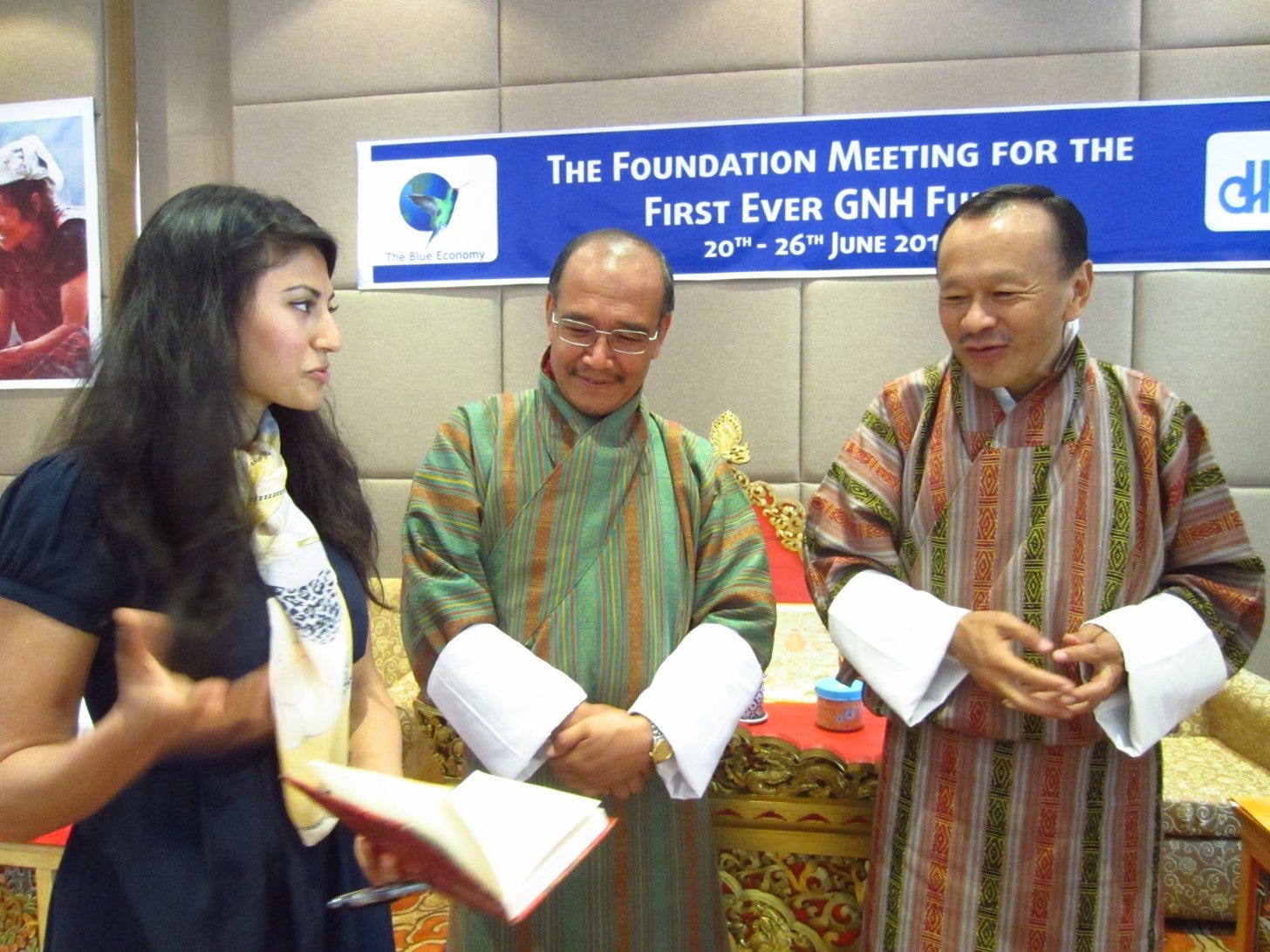
What struck me was less the numbers than the premise. Sustainability and net zero are ways of limiting damage: consume less, emit less, offset what remains. In its crudest form, net zero says that whatever harm you have done, you can plant some trees. Both accept extraction as the starting point. A healthy ecosystem works differently. A mature forest produces more than it uses up, and that surplus builds soil, supports biodiversity and keeps the air breathable. Net Positive asks whether a building, a clinic, a supply chain or an investment portfolio could work the same way, and the Replenish Earth audit methodology exists to make that measurable rather than hopeful.

The term has since travelled into the corporate world, most visibly through Paul Polman and Andrew Winston’s 2021 book Net Positive. My own work on it began in Bhutan ten years earlier, with living systems rather than balance sheets as its unit of measure. I have been building on it ever since: in my 2015 talk Replenish at TEDxSanFrancisco, in Replenish: Giving our Earth more than we take at TEDxPenn in 2017, in Replenish, The New Economy at Talks at Google, and in the World Replenish Index, which I introduced in November 2017 at the 7th International Conference on Gross National Happiness, hosted by the Centre for Bhutan & GNH Studies.

In 2016 and 2017 I took groups of students from across India to Bhutan. Some asked why we were not going to London or Zurich instead. On the road from Paro to Thimphu the bus suddenly stopped and everyone poured out. I had been dozing, and when I asked what was happening, one student said: “Ma’am, we have never seen such a clean river.” That was when I knew it would be a trip worth taking.

You cannot design the person
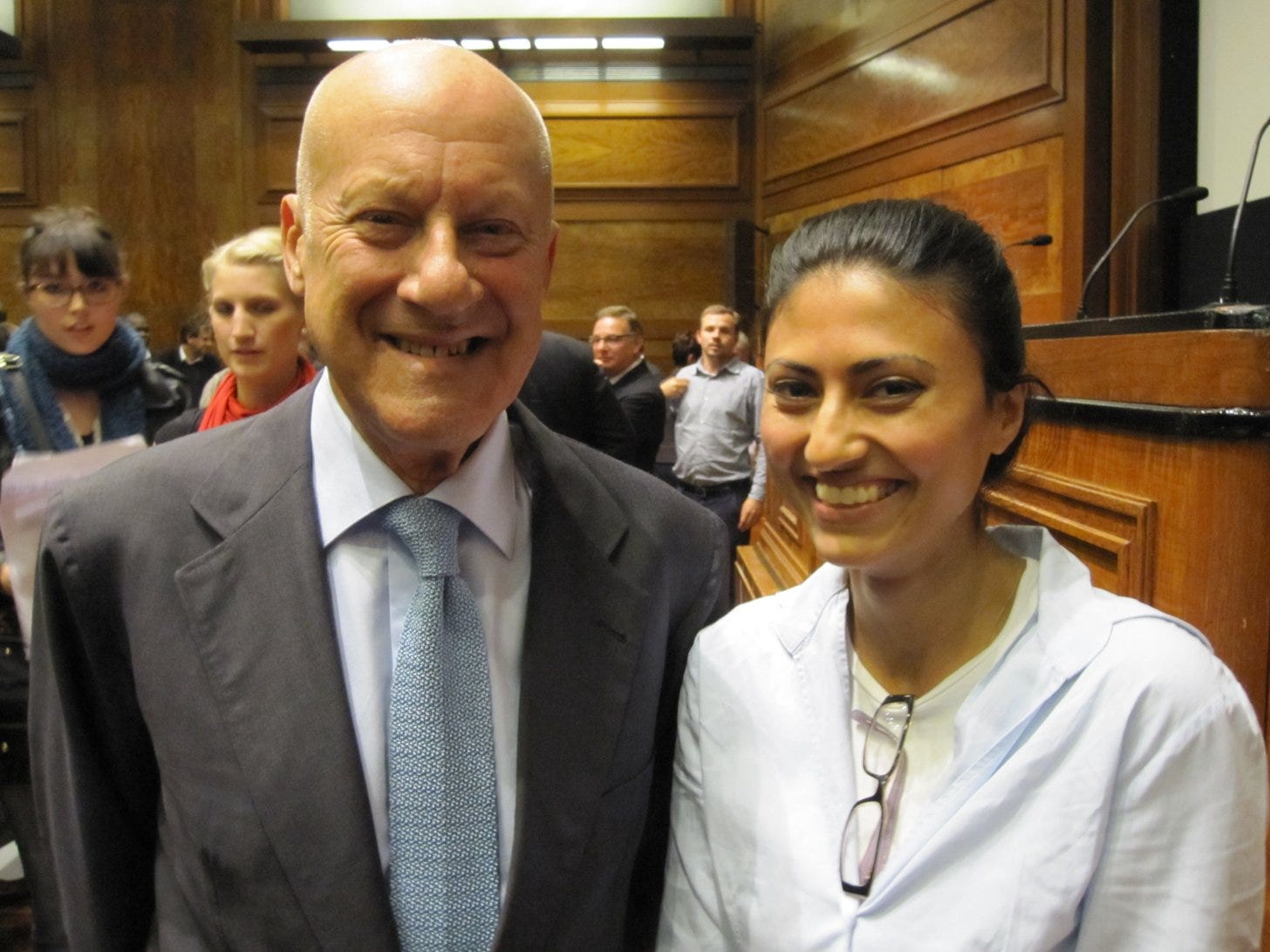
During my doctorate I studied Masdar City in Abu Dhabi, launched as the world’s first zero carbon, zero waste city and masterplanned by Foster + Partners. It struggled, I told George, because it did not ask the people who would live there. I set out a way of asking them in Post Occupancy Evaluation of buildings in a Zero Carbon City, published in Sustainable Cities and Society in 2012.
The first residents were students at the Masdar Institute of Science and Technology, developed with MIT. In their rooms the temperature was fixed at 25 degrees Celsius. There was a thermostat, but it did not work, and the building was sealed. The intention was sound: avoid overcooling and keep energy use low. Yet I found students with doors and windows flung open, condensation forming in the air conditioning, damp spreading, and with damp, mould. Mould makes people ill.
“You can design a building the way that you want, but you cannot design the person that lives in that building.”
The building has to respond to its occupant. Part of the reason we get this wrong is that we design for averages. Much of the world’s thermal comfort standard traces back to the Danish engineer Ole Fanger, who around 1970 placed young volunteers in climate chambers, turned the temperature up and down, and asked whether they were comfortable. It was careful research, and it became the basis for comfort standards in buildings around the world.
But nobody is average. My mother, who grew up in India, is comfortable at 25 degrees or above; my father prefers it cooler, and every winter they negotiate the heating. Each of us carries a thermal baseline shaped by where we come from. We also feel more comfortable when we can open a window or change the thermostat ourselves: control is a form of comfort in its own right.
For my doctoral research I audited 20 buildings in fine detail, alongside energy and water data for around 90,000 buildings gathered with several government departments. It was the granular data that explained why people felt unwell indoors. When I trialled raising the temperature of entrance lobbies by just 1°C, the space between the heat outside and the cool inside, cooling demand appeared to fall without any loss of occupant satisfaction. The environment can stress the body without the mind ever noticing. Light, sound, air and materials reach the nervous system before we have a single thought about them.
Ask the people who will live there
George raised a question every city will soon face: people in their twenties living alongside people over a hundred, five generations apart. The young need stimulation; the old need safety. How do we design for both?
My answer began in Vienna. In 1991 the city held an exhibition called Who Owns Public Space?, about women’s everyday lives in the city. As I described it to George, the work followed women of different ages and circumstances through the streets: a mother with a pram, a grandmother with a walking stick, a woman in a wheelchair, a girl walking home after dark. It recorded where the city failed each of them. A kerb too high to lift a pram onto the bus. No bench where an older woman could rest, so she never walked far from home. Too few dropped kerbs. Parks too dark to feel safe. The planners did not arrive with solutions. They simply showed people what life in their city was like, and the politicians who came were moved. Vienna went on to become a pioneer of planning around everyday experience.
Future places of longevity have to start there: with the people who will live in them. One tool for this is post occupancy evaluation, which means measuring how a building actually performs once people are living in it, not only how it was meant to perform on paper. I want to add the nervous system to that evaluation, so that we ask not only whether people are comfortable, but whether the building supports their physiology.
Retreats as laboratories
George pressed me on whether the wellness industry overpromises. I think it sits on an edge. Medicine’s research follows funding, and funding follows a business case built largely around treatment. Wellness is paid for directly by its guests, which leaves it freer to experiment. That freedom carries responsibility. Part of what people feel after a good retreat may be the placebo effect: a beautifully designed experience, or a warm conversation with someone like George, can lift a person’s outlook and shift their hormones with it. That effect is real, and it is exactly why practitioners need proper training and why claims need credentials behind them.
This is where retreats could become laboratories, not only places of rest. With guests’ consent, a centre could gather measures such as heart rate variability, skin conductance and sleep, and map them against the spaces people move through: which room, which light, which scent brought the deepest rest. When George asked what a pilot between Chenot and Replenish Earth might set out to prove, my answer was the biological impact of the place itself, measured from the moment a guest arrives to the moment they leave.
A standard for the nervous system
A truly regenerative place, I told George, has to be as close to nature as possible, because the human body was shaped by natural ecosystems. Every step away from that, towards synthetic materials, sealed air and artificial light, asks the body to adapt to something it was not built for. Even our science can fall into the habit. We isolate curcumin from turmeric to prove that it works, and lose sight of the whole plant and why it exists.
“We think in parts, not in wholes.”
His final question was what the world looks like in ten to fifteen years if this work succeeds.
“In 10 to 15 years there will be standards that allow for the nervous system to be tested in every environment.”
That is the purpose of Nervous System Compliant™ Design, the standard I set out here on this Substack earlier this year: buildings measured by what they do to the people inside them. And beyond the human nervous system lies the nervous system of the planet, the living systems that hold and host our own. Longevity cannot be achieved by one body in isolation. It depends on the health of every system the body lives inside.
Thank you again to George and to Chenot. You can watch the full conversation on YouTube. I would love to hear from you in the comments: which building in your life makes you feel most at ease, and why?
Replenish Earth is a reader-supported publication. To receive new posts and support my work, subscribe for free.
More from Dr Tia Kansara
Replenish, TEDxSanFrancisco
Replenish, The New Economy, Talks at Google
The World Replenish Index, Centre for Bhutan & GNH Studies
The impact of increasing temperatures in transition zones in Abu Dhabi on thermal comfort and energy demand, my doctoral thesis, UCL (2016)
Post Occupancy Evaluation of buildings in a Zero Carbon City, Sustainable Cities and Society (2012), with I. Ridley
Introducing Nervous System Compliant™ Design, on this Substack
The Human Exposome, my co-authored chapter in Frontiers of Longevity Science (Springer Nature)
Together We Rise, my interview series
Sources
Rappaport SM, Smith MT. Environment and disease risks. Science, 2010.
Argentieri MA et al. Integrating the environmental and genetic architectures of aging and mortality. Nature Medicine, 2025.
Klepeis NE et al. The National Human Activity Pattern Survey (NHAPS). Journal of Exposure Analysis and Environmental Epidemiology, 2001.
Constitution of the Kingdom of Bhutan, 2008, Article 5.
Fanger PO. Thermal Comfort. Danish Technical Press, 1970.
Who Owns Public Spaces? The trailblazer exhibition on women’s everyday life in the City of Vienna (1991). Planning Perspectives.
Polman P, Winston A. Net Positive. Harvard Business Review Press, 2021.
Watch the episode: Beyond Longevity: Designing the Conditions for Health, Chenot Podcast.
