

I recently joined Wendy’s Science of Calm Summit as a speaker, and what unfolded over the course of that conversation was (for me at least) one of those rare exchanges where you lose track of time, where every question opens another door, and where you end up somewhere you didn’t quite expect to go when you first sat down.
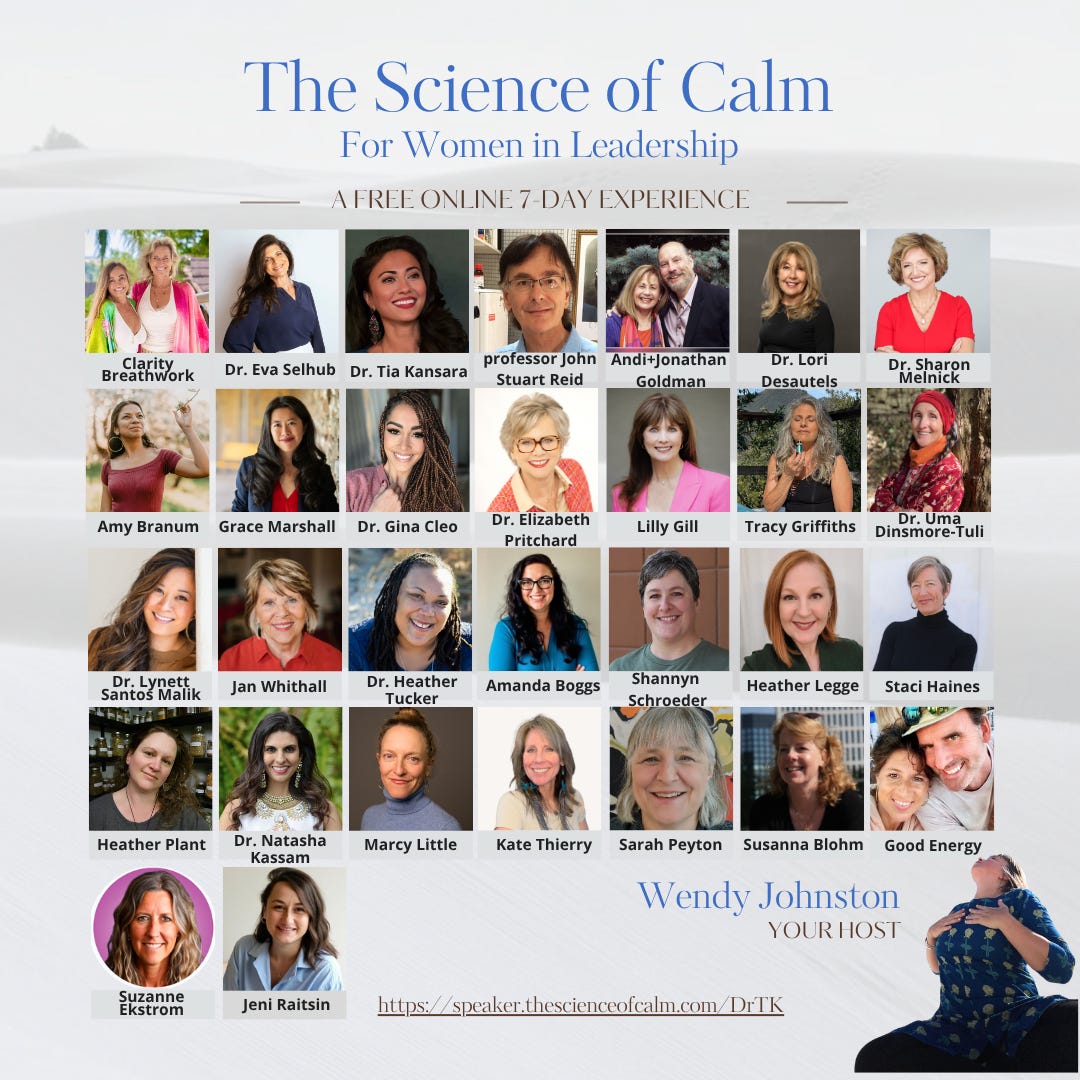
So I wanted to share some of it with you here, along with a free resource I created especially for summit attendees (and now, for you) a Calm Audit that requires no special expertise, no renovation budget, and absolutely no architectural degree.
More on that in a moment. First, let me set the scene.
The Question Nobody Thinks to Ask About Their Office
Most of us walk into a room, feel vaguely off, and assume it’s us. We’re tired. We’re stressed. We haven’t meditated enough. We need another coffee.
We rarely look at the walls.
But as an ecosystem engineer, someone whose work sits at the intersection of built environments, living systems, and human nervous system health, I’ve spent decades learning something that I believe is quietly urgent: your physical environment is in constant conversation with your body, and largely, you’re not part of that conversation.
It’s happening without you.
When Wendy asked me to describe what an ecosystem engineer actually does, I explained it this way: rather than designing against nature (against the grain, against the climate, in service only of human needs) ecosystem engineering asks what conditions allow all life to thrive here. What signals is this environment sending to the bodies and nervous systems of the people inside it? What is it restoring, and what is it depleting?
The answer, in most modern buildings, is quietly damning.
The Silent Dysregulators Around You
Here are the four that came up most vividly in our conversation and that I see most consistently in the 1,000s of buildings I’ve analyzed over the years (and during my PhD research at UCL in particular):
1. Unpredictable acoustic noise. Not just loud noise. Uncertain noise. Your autonomic nervous system is continuously scanning its environment, a process called neuroception, asking, at a level far below conscious awareness: is this safe? Unpredictable, unfamiliar sounds are one of the most reliable triggers of low-level chronic threat detection. You may feel it as vague unease, poor concentration, or the sense that you can’t quite settle. It may never occur to you that the HVAC hum, the open-plan office chatter, or the unpredictable traffic outside your window is the reason.
2. The absence of living systems. We now have videos of plants breathing their stomata opening and closing, the quiet animation of photosynthesis. We spend 80% of our lives inside buildings, and the modern built environment has become extraordinarily efficient at removing every living thing from those spaces. And then people wonder why they can’t remember things, why they can’t regulate their emotions, why creativity feels exhausted. Neuroscience is unambiguous: contact with nature - even visual contact with green, living things - upregulates neurogenesis in the hippocampus, the brain region most critical for memory and emotional regulation.
3. Visual overload and cognitive chaos. The prefrontal cortex, the seat of your executive function, your decision-making, your emotional regulation is doing constant spatial housekeeping in every room you enter. Whether a space feels cluttered or clear, whether wayfinding is intuitive or confusing, whether the visual coherence of the environment feels restful or draining all of this is running as background processing. When it costs too much, your executive function pays for it. And in an age of open-plan offices, hot-desking, and digitally saturated walls, the cost is considerable.
4. Light deprivation. My partner is currently driving a significant initiative around UVB regulation and light spectrum and the research is increasingly clear. Your body’s hypothalamic-pituitary-adrenal axis (the primary stress management system) is deeply responsive to light quality and spectrum. Fixed, artificial lighting in most workplaces disrupts circadian rhythms, suppresses mood and cognition, and undermines immune function in ways that accumulate slowly, chronically, invisibly. The simple act of having access to a horizon- of pausing and allowing your gaze to expand across a panoramic view, is a meaningful intervention for the nervous system. Most offices offer no such thing!
What a Space Built for Calm Actually Feels Like
When Wendy asked me to describe environments that I’ve encountered in my life that were genuinely designed for calm, I told her something that might be unexpected: the places that stay with me are rarely grand architectural statements.
They’re the ones that understood proportion, solitude, quiet, and nature contact, simultaneously. A courtyard in Marrakesh. A traditional Japanese garden. A sacred building where sound, light, and material conspired to produce something that researchers might call biophilic coherence a layered alignment of sensory inputs that doesn’t shove you through a space, but invites all of you in.
These are not accidents. Many of them are thousands of years old. They are the accumulated trial and error of human civilizations trying to understand what it means for a body to feel safe in a place.
We’ve largely stopped building that way. And we’re paying for it.
The Rainbow of Buttons
One of my favourite moments in the conversation came when we got onto the theme of the on/off binary that governs so many of our days.
Many of us have exactly two settings: ON -working, performing, producing, achieving and OFF: collapsed, exhausted, absent. And we live with the chronic consequences of both extremes, with very little between them. What I tried to offer was this image: that grey area between on and off? It doesn’t need a single dial. It needs a whole rainbow of buttons. Pockets of soft fascination. Moments of sensory transition. Rituals even small ones that bring you back into the body between the demands of the day.
A plant in the meeting room. A bowl of coffee beans to transition the senses. A window view to the sky. A moment of deliberate, full-body contact with the surface you’re sitting on. Lavender essential oil on your desk.
None of these are luxury additions. They are, from a neuroscientific standpoint, genuine micro-interventions in your regulatory state. And they compound.
Designing Regeneratively (For Yourself)
The conversation eventually arrived somewhere I find most meaningful: the relationship between choice and calm.
You may not be able to redesign your office building (!). You may not have control over the acoustics of your open-plan floor, or the quality of the light in your meeting rooms, or whether there are plants in the corridors. But the most important factor for comfort in a physical space is your control over it, however, small.
You have a choice in how your bedroom is arranged. You have a choice in what you put on your desk. You have a choice in whether you keep lavender at your workstation, or step outside between calls, or eat your lunch somewhere with a view of green. If you haven’t made those choices, someone else has and that default was never designed with your nervous system in mind.
A useful exercise: give your space a mark out of ten. Not for aesthetics. For how it makes you feel. And then ask: what would make it a ten? What would give you pockets of restoration, of sacred ritual, of genuine rest? What would allow your body to tell the difference between focus and replenishment to move fluidly across those seasons, those rhythms, those needs that change week to week and month to month?
The Free Calm Audit (Start Here)
I brought a free Calm Audit to the summit, a simple and accessible guide that walks you through the sensory dimensions of any space you inhabit.
It’s not a technical document. It’s an invitation to get curious. It covers the workplace, the home, individual rooms, wherever you spend your time. And it begins to ask the questions that most of us have never thought to ask: What does this space smell like, and what might I want it to smell like? What’s the soundscape? What’s the quality of light? What’s the visual coherence of this environment, and how is it affecting my capacity to think and feel and rest?
There’s a deeper version of the audit available for those who want to go further a full-scale environmental assessment that I do with clients and organizations. But this is where curiosity begins.
👉 Download the free Calm Audit here
Share it with your team. Do it together. Let me know what you discover.
A Final Word
What struck me most about this conversation and what I carry with me from all of the conversations I have about this work is how personal it is. Wendy described walking into a house and feeling it. Feeling it as a visceral, bodily thing, before a single intellectual word had been formed about it.
We all know that feeling. We’ve always known it.
This work is, in some ways, about giving language to what the body already knows and then giving ourselves permission to act on it. That’s what Nervous System Compliant™ design is, in its most essential form: a formal language for what your body has always been trying to tell you. Because here is the truth: your environment is either restoring you or depleting you. And you are allowed to have something to say about which one it is.
If you are in financial difficulty let me know and I’ll see what I can do about getting the interview to you.
